
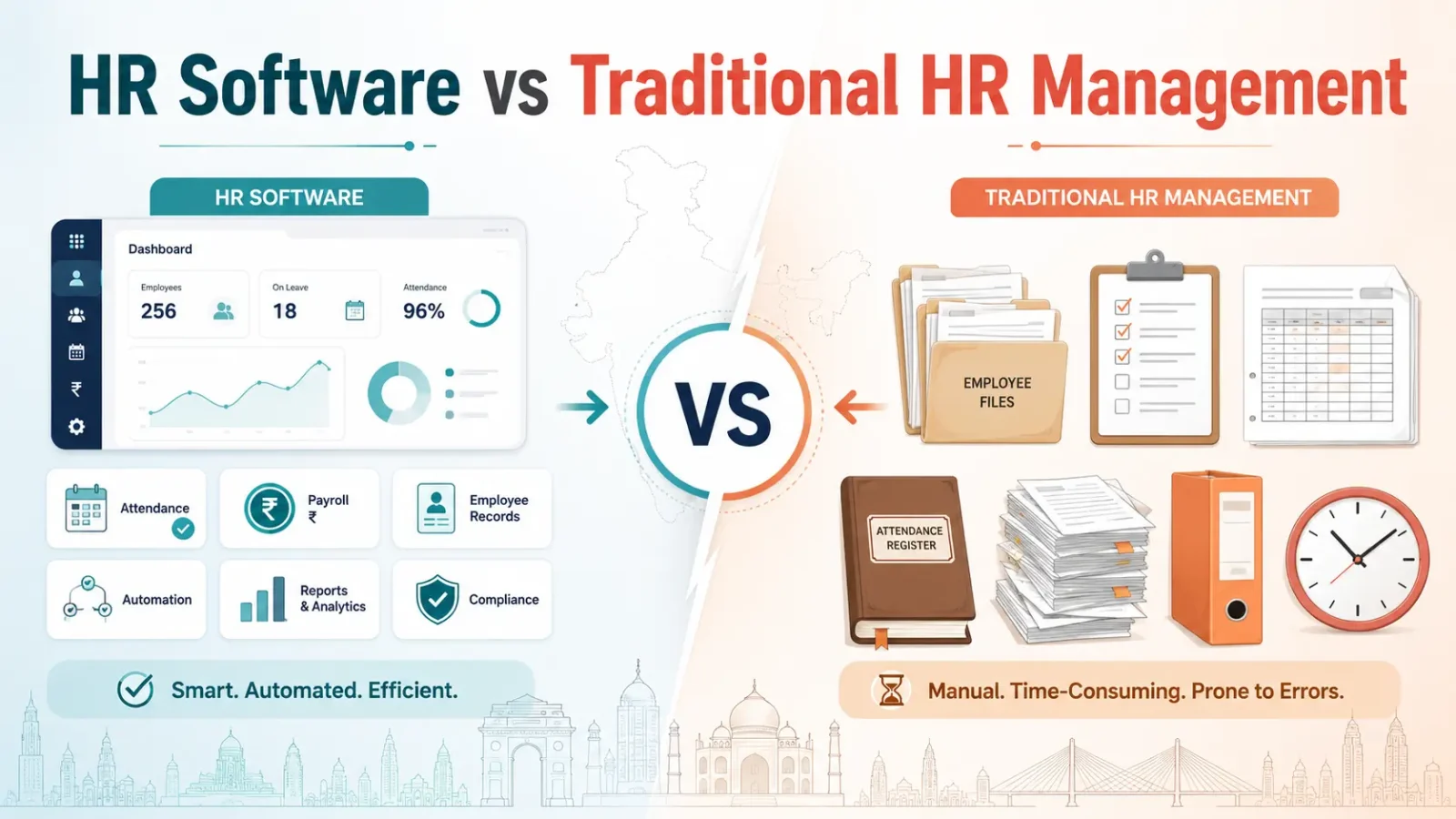
HR software vs traditional HR management is the most important operational decision growing Indian businesses face today. HR software automates payroll, attendance, compliance, and employee data management through a centralized digital platform — replacing the manual spreadsheets, paper registers, and email-based approvals that traditional HR depends on. The difference is not just about speed; it directly impacts accuracy, compliance risk, employee experience, and your ability to scale.
In my experience advising Indian SMBs across Mumbai, Pune, and Bangalore, companies typically hit a breaking point around 30–50 employees. That is when spreadsheet-based HR buckles under compliance pressure, payroll errors compound, and employee dissatisfaction with slow manual processes becomes visible. This guide breaks down exactly how HR software compares to traditional methods — covering features, costs, compliance, scalability, and a clear decision framework to help you choose.
Key Takeaways:
- HR software automates payroll, attendance, and compliance — traditional HR relies on manual spreadsheets and paper processes.
- Indian compliance requirements (EPF, ESIC, PT, TDS) make automated HR practically essential for companies above 30 employees.
- HR software costs ₹40–₹200 per employee per month — typically paying for itself within 6–12 months through error reduction and time savings.
- Traditional HR still works for stable teams under 20 employees with minimal compliance complexity.
- The best choice depends on your company’s size, growth trajectory, and compliance burden.
What Is Traditional HR Management? How It Works in Indian Companies
Traditional HR management is the manual, paper-based approach to handling workforce operations that most Indian companies have used for decades. It typically involves physical attendance registers, Excel-based payroll calculations, paper leave application forms, employee records stored in filing cabinets, and compliance tracked through memory or basic calendars.
Common elements of traditional HR in Indian organizations include:
- Leave Applications: Handwritten or printed forms requiring multiple physical manager signatures before being handed to HR.
- Attendance Tracking: Physical biometric registers or punch cards that must be manually exported and fed into Excel sheets at the end of the month.
- Payroll Processing: Salary calculation done manually with separate, complex computations for PF, ESIC, Professional Tax, and TDS.
- Data Storage: Employee records, KYC documents, and contracts stored in physical files organized by department in cabinets.
- Performance Reviews: Conducted through paper forms or disconnected Word documents once or twice a year, making it hard to track historical progress.
- Recruitment: Managed via job portals like Naukri or LinkedIn, with candidate shortlisting tracked manually in massive, hard-to-read spreadsheets.
Why Traditional HR Management Fails Growing Indian Businesses
Quick Answer: Traditional HR management fails to support growing Indian businesses because manual spreadsheet processes cannot scale beyond 30–50 employees without severe operational leaks. Relying on paper files and Excel leads to a 3-5% payroll error rate, unmanageable compliance risks due to changing EPF, ESIC, and state tax laws, and a frustrating employee experience that hurts retention.
1. The “50-Employee” Breaking Point
When a company has 15 employees, managing leave balances on Excel and salaries on a calculator is feasible. However, once an Indian business scales to 50+ employees, the variables multiply exponentially. Factoring in pro-rata salaries, unpaid leave (LOP), variable overtime (OT) hours, and mid-month joiners across departments manually guarantees a 3-5% error rate—costing the company significant money through overpayments or triggering employee frustration due to underpayments.
2. The Trap of Dynamic Indian Labour Laws
Indian statutory compliance is highly complex and constantly changing. Manually managing EPF wage limits, ESIC contribution thresholds, and state-wise Professional Tax (PT) slabs is a major operational risk. For example, failing to update PT deductions for employees working across different states (or missing a Maharashtra Labour Welfare Fund deadline) doesn’t just result in standard penalties ranging from ₹5,000 to ₹1 lakh; it can invite deep regulatory audits that freeze business operations.
3. Attendance Leaks for Distributed and Field Teams
Traditional biometric wall machines work well for a single factory floor, but they don’t fit modern business models. Whether you have sales teams navigating Mumbai traffic, field workers in regional hubs like Pune or Rajkot, or staff working from home, physical registers and static biometrics cannot track them. This forces HR to manually reconcile email check-ins with biometric data at the end of the month—a process that takes days and is highly vulnerable to “buddy punching” and time theft.
4. HR Becomes a Data-Entry Department, Not a Strategic Partner
With traditional systems, scaling your business means scaling your HR headcount proportionately just to keep up with the paperwork. Instead of focusing on strategic initiatives—like building company culture, upskilling employees, or recruiting top talent—your HR professionals spend 80% of their month doing data entry, chasing manager signatures for leave approvals, and answering routine payslip queries.
What Is HR Software and How Does It Transform HR Operations?
HR Software (often referred to as an HRMS or HRIS) is a digital, cloud-based platform that centralizes and automates the entire employee lifecycle. Instead of scattered spreadsheets, all data lives in one secure system.
Here is how it transforms core operations:
- Automated Payroll Processing & Compliance: Calculates net pay in minutes. It automatically deducts the exact, legally required amounts for EPF (12%), ESIC (3.25%/0.75%), PT, and TDS, and even generates Form 16/24Q for tax filing.
- Integrated Time & Attendance: Syncs directly with biometric hardware (like ZKTeco or eSSL) or uses mobile GPS geo-fencing to capture attendance in real-time. No more end-of-month data reconciliation.
- Employee Self-Service (ESS): Gives employees a mobile app to download payslips, apply for time off, declare tax investments, and raise helpdesk tickets independently.
- Centralized Database: Acts as a single source of truth for all employee records, tracking everything from onboarding workflows to asset allocations and promotion history securely in the cloud.
HR Software vs Traditional HR Management: Complete Side-by-Side Comparison
| Feature/Metric | Traditional HR Management | HR Software (HRMS) |
|---|---|---|
| Core Method | Manual spreadsheets, paper registers | Automated, cloud-based digital platform |
| Payroll Processing Time | 4 to 6 days | 2 to 4 hours |
| Error Rate | High (3% – 5% average) | Near Zero (Below 0.5%) |
| Setup Time | Immediate (using existing tools) | 2 to 8 weeks (depending on size) |
| Upfront Cost | None | Low to Moderate (Implementation fees) |
| Monthly Running Cost | High (Cost of HR admin hours) | Fixed subscription (₹40–₹200/user/mo) |
| Compliance Management | Manual tracking: high risk of penalties | Auto-calculated; alerts for deadlines |
| Data Security | Vulnerable to theft, loss, or hardware failure | Bank-grade cloud encryption (ISO/SOC2) |
| Reporting Capability | Takes hours to compile manually | Instant, real-time visual dashboards |
| Employee Experience | Frustrating; dependent on HR availability | Empowering; 24/7 mobile self-service |
| Scalability | Requires hiring more admin staff | Scales infinitely with a few clicks |
| Accessibility | Restricted to the office/physical files | Accessible anywhere via mobile or web |
Cost Comparison: HR Software vs Traditional HR Management in India
Traditional HR looks cheaper on the surface — you already have Excel, and paper registers cost nothing. But I always tell clients to calculate the hidden costs honestly:
- An HR executive spending 4 days on payroll each month (salary cost: ₹8,000–₹12,000 equivalent in wasted time).
- An accountant spends 2 days on statutory filings.
- Compliance penalties from missed deadlines (₹5,000–₹1 lakh per violation).
- Employee dissatisfaction from delayed salaries or payslip errors.
HR software pricing in India typically ranges from:
- Basic HRMS: ₹40–₹60 per employee/month (Core payroll + attendance).
- Mid-range HRMS: ₹80–₹150 per employee/month (Full HR suite, onboarding, performance).
- Enterprise HRMS: ₹200+ per employee/month (Custom workflows + advanced integrations).
For a 100-employee company on a mid-range plan, that is approximately ₹8,000–₹15,000/month. This is almost always less than the hidden financial leaks of manual HR. Most Indian companies see a complete return on investment (ROI) within 6–12 months.
How to Choose Between HR Software and Traditional HR Management
Not every business needs comprehensive HR software immediately. Use this team-size framework to decide:
- Under 20 Employees: Traditional methods can still work if well-organized. Simple payroll software might be enough without a full HRMS.
- 20–100 Employees: HR software starts showing clear ROI. This is the stage where manual processes break, and automating attendance and compliance becomes critical.
- 100+ Employees: Manual processes become genuine bottlenecks. An integrated HRMS is non-negotiable for scaling.
Take this 5-point self-assessment to decide if you are ready to switch:
- How many hours does your HR team spend on routine admin weekly?
- How often do payroll errors (over/underpayment) occur?
- Can you generate compliance reports (like PF/ESIC summaries) on demand?
- Is your team growing beyond 50 employees in the next 1–2 years?
- Do employees frequently complain about slow HR response times for basic requests?
If you answered negatively to two or more, it is time to upgrade.
Why Indian SMBs Are Switching from Traditional HR to HR Software
Risk-Free Local Compliance
Keeping up with Indian labor laws is exhausting. State-specific rules like the Maharashtra Labour Welfare Fund (MLWF) or changing national income tax regimes require constant vigilance. HR software automatically updates its backend to reflect these changes, helping your business stay compliant without manual research.
Error-Free, One-Click Payroll
By integrating attendance data directly with salary computation, HR software removes the human element from data entry. Loss of pay (LOP), overtime (OT), and tax deductions are calculated mathematically, ensuring your team is paid perfectly and on time, every single month.
Ready for Hybrid and Field Workforces
The traditional biometric machine doesn’t work for field sales teams or remote workers. Modern HR software uses mobile apps with GPS geo-fencing and facial recognition, allowing employees to mark their attendance accurately from client sites or home offices.
Instant Data and Strategic Analytics
Instead of guessing your attrition rate or manual compiling overtime costs, HR software gives leadership instant dashboards. You can see headcount trends, departmental costs, and diversity metrics at a glance, allowing you to make proactive business decisions.
Massively Improved Employee Experience
Giving employees a self-service app changes the culture of a company. When staff can download their Form 16, check their holiday calendar, and apply for sick leave from their couch—without bothering HR—it builds immense trust and transparency.
Saving Time for Strategic HR
When you remove the burden of data entry, HR professionals can actually do Human Resources. They can focus on culture building, upskilling employees, improving retention, and recruiting top talent—activities that actually grow the business.
Affordable SaaS Pricing Removed the Barrier
Ten years ago, HR software was a luxury only enterprises could afford. Today, cloud-based SaaS models mean even a 25-person startup can access enterprise-grade tools for the price of a few office lunches a month.
Why an India-Built HRMS Outperforms Global Tools for Indian Businesses
When upgrading from traditional systems, you might be tempted by flashy global tools. However, if you evaluate the best HRMS software in India, you’ll find that an India-built HRMS is almost always the superior choice.
Global platforms struggle deeply with Indian statutory complexities. They cannot easily handle the nuances of EPF (12% employer + 12% employee), ESIC limits, or the generation of Form 24Q. An India-built system is natively coded to comply with these laws. Furthermore, local software providers offer customer support during IST business hours, provide regional-language interfaces to aid adoption among blue-collar staff, and natively integrate with Indian accounting staples such as Tally.
Frequently Asked Questions
Is HR software worth the investment for small Indian companies?
For companies with 20 or more employees, HR software typically delivers positive ROI within 6–12 months. Time savings on processing using a top payroll software in Mumbai (from 4–5 days to under 1 day), elimination of compliance penalties, and reduction in payroll errors more than offset monthly subscription costs of ₹40–₹80 per employee.
What is the main difference between HR software and traditional HR management?
HR software automates payroll, attendance, leave management, and compliance through a single digital platform. Traditional HR management relies on manual processes — paper forms, Excel spreadsheets, and physical registers. The key differences are speed (hours vs days for payroll), accuracy (below 0.5% vs 3-5% error rate), compliance, safety, and employee experience.
How long does HR software implementation take in India?
Most cloud-based HR software implementations take 2–8 weeks. Basic payroll and attendance setup can go live within 2 weeks. Full implementations with integrations, data migration, and custom workflows typically need 4–8 weeks, depending on company size and data complexity.
Can HR software handle Indian statutory compliance like PF, ESIC, and Professional Tax?
Yes. HR software built for India handles EPF (12% employer + 12% employee), ESIC (3.25% employer + 0.75% employee), state-wise Professional Tax, TDS under Form 16/24Q, Gratuity, and Bonus Act calculations automatically.
What should I look for when choosing HR software in India?
Prioritize: (1) Indian compliance support, (2) Local customer service during IST business hours, (3) Mobile accessibility for managers and employees, (4) Integration with Tally and biometric devices, (5) Transparent per-employee pricing with no hidden costs, (6) Data security certifications and cloud backup.
How much does HR software cost in India?
HR software in India ranges from ₹40–₹60 per employee/month for basic plans, ₹80–₹150 for mid-range full-suite solutions, and ₹200+ for enterprise platforms. A 100-employee company typically spends ₹8,000–₹15,000/month.
