
It is the 28th of the month. Payroll is due in 48 hours. Your HR manager is buried in Excel, cross-referencing attendance sheets while answering employee WhatsApp messages about salary slips. Your accountant is asking for headcount data. Three employees are disputing their leave balances. And the HRMS you are already paying for requires 12 steps just to generate a payslip.
If this sounds familiar, you are not alone. Thousands of Indian businesses, from 15-person startups in Bengaluru to 600-person manufacturing units in Pune, are running critical HR operations on tools that were never designed for India’s complexity: state-wise Professional Tax slabs, PF ECR generation, variable salary structures with LTA and HRA, and last-minute Budget TDS updates.
At HR Software Mumbai, we work with Indian businesses every day on exactly these challenges. For this guide, we independently evaluated 12 of the most widely used HRMS platforms available in India for 2026. We tested each platform against Indian payroll compliance requirements, ease of adoption, pricing transparency, attendance integration, and scalability from 10-employee startups to 2,000-employee enterprises.
No platform paid for its position. No affiliate commissions influenced the rankings. By the end of this guide, you will know exactly which platform fits your company size, budget, and compliance requirements and which ones to avoid.
What You Will Get in This Guide
- A clear definition of what HRMS software is and how it differs from basic payroll tools
- A 7-point evaluation framework specific to Indian business requirements
- Detailed, independent reviews of 12 platforms with pricing, pros, cons, trust signals, and a “Best For” verdict on each
- A complete side-by-side feature comparison table
- A full pricing comparison across all 12 platforms
- A Final Verdict decision guide segmented by company size, use case, and budget
- A step-by-step HRMS implementation guide for Indian businesses
- 12 frequently asked questions answered in plain language
What Is HRMS Software? (And How Is It Different From Payroll Software?)
HRMS stands for Human Resource Management System. It is a centralised digital platform that manages the complete employee lifecycle within an organisation from the moment a candidate applies for a job to the day an employee retires or exits.
A basic payroll tool only calculates and processes salaries. An HRMS does far more:
- Payroll processing: Salary calculation, statutory deductions, payslip generation, and direct bank transfers
- Attendance management: Real-time clock-in tracking, biometric device integration, geo-fenced attendance for field and remote teams
- Leave management: Leave application, multi-level approval workflows, leave balance tracking, and customisable holiday calendars
- Indian statutory compliance: Provident Fund (PF), Employees’ State Insurance (ESIC), Professional Tax (PT, which varies by state), Tax Deducted at Source (TDS under old and new regimes), Labour Welfare Fund (LWF), Form 16, and challan filing
- Employee self-service portal: Employees access payslips, apply for leave, update personal records, and raise IT declarations without contacting HR
- Performance management: Goal setting, appraisal cycles, 360-degree feedback, and OKR tracking
- Recruitment and onboarding: Applicant tracking, offer letter generation, and digital onboarding workflows
The distinction matters because many Indian businesses purchase a payroll tool and mistake it for an HRMS. If your software cannot handle attendance-to-payroll integration, multi-state PT compliance, and employee self-service simultaneously it is a payroll calculator, not an HRMS.
Quick Verdict: Top 12 HRMS Software in India (2026)
For those who need a fast answer before reading the full reviews:
- factoHR: Best overall mobile-first HRMS for Indian SMEs
- Keka HR: is best for mid-size companies with dedicated HR teams
- greytHR: Best for payroll compliance-focused organisations
- Darwinbox: is best for large enterprises with complex, multi-location HR needs
- Zoho People: is best for businesses already running on the Zoho ecosystem
- HROne: Best for companies transitioning from manual or spreadsheet-based HR
- Pocket HRMS: Best AI-powered HRMS for SMEs with distributed workforces
- Zimyo: is best for startups prioritising employee engagement alongside core HR
- Spine HR Suite: is the best end-to-end platform for multi-location businesses
- uKnowva HRMS: is the best customisable HRMS for non-standard industry processes
- Qandle HR: Best mobile-first platform for fast-scaling businesses
- WoCo: is the best budget-friendly all-in-one HRMS for growing SMEs
How to Choose the Right HRMS Software for Your Indian Business
Most companies evaluate HRMS software backwards; they look at the feature list before understanding whether the platform fits their actual context. Use this 7-point framework before booking a single demo. It will save you weeks of wasted time.
1. Verify Indian Statutory Compliance Coverage First
This is your absolute first filter and the point where most international and even some Indian tools fail. India’s payroll compliance is among the most complex in Asia. Your HRMS must natively handle all of the following without requiring manual intervention:
- Provident Fund (PF): Employee and employer contributions at 12% each, ECR (Electronic Challan cum Return) generation, UAN management, and Form 3A/12A annual returns. The system should automatically identify employees crossing the ₹15,000/month Basic + DA threshold.
- Employees’ State Insurance (ESIC): Applicable for employees earning up to ₹21,000/month. The system must calculate contributions (employee: 0.75%, employer: 3.25%), generate monthly ECR, and maintain Form 1 and Form 3 records.
- Professional Tax (PT): This is where many platforms fail. PT is state-administered, meaning Maharashtra, Karnataka, West Bengal, Tamil Nadu, Telangana, Andhra Pradesh, and other states each have different slabs, filing frequencies, and exemption rules. If your business operates across multiple states, your HRMS must handle multi-state PT without manual workarounds.
- TDS on Salary: The system must support both the old and new income tax regimes introduced under Budget 2023 and updated in Budget 2024-25, including the new ₹12 lakh standard deduction applicable from FY 2025-26. Employees must be able to declare their regime, and the system must calculate TDS accordingly.
- Form 16 and Form 12BB: Automated generation and digital distribution to employees at year-end.
If a vendor cannot demonstrate all of the above in their product demo with live examples, remove them from consideration immediately.
2. Insist on Native Attendance-to-Payroll Integration
The single biggest source of payroll errors in Indian organisations is the manual transfer of attendance data into payroll calculations. If your HRMS exports an attendance CSV that someone then imports into a payroll module, that is not automation. That is a digital spreadsheet with extra steps, and it introduces human error at exactly the point where errors are most costly.
Your chosen HRMS must automatically carry attendance data including overtime, late arrivals, half-days, leave deductions, and comp-off adjustments directly into payroll processing with zero manual data transfer. Ask the vendor to demonstrate this specific workflow during your demo.
3. Choose Cloud-Based Over Desktop-Based Without Exception
In 2026, there is no valid business reason to choose a desktop-installed HRMS over a cloud-based one for any Indian company. Desktop-based systems require local installation, manual update management, hardware maintenance, and create a data loss risk from device failure. They cannot support remote employees, multi-location operations, or on-the-go manager approvals.
Cloud-based HRMS gives you access from any device, automatic compliance updates when government regulations change (such as post-Budget TDS slab revisions), pay-as-you-go pricing with no capital expenditure, and automatic data backups. If any vendor proposes a desktop-based deployment in 2026, treat it as a red flag.
4. Test the Employee Self-Service Portal on Mobile Before Deciding
An employee self-service (ESS) portal is one of the highest-ROI features in any HRMS. Indian HR teams report that 40-60% of their daily queries are routine requests, such as payslip downloads, leave balance checks, attendance corrections, and IT declaration submissions. A well-designed ESS portal eliminates all of these completely, freeing HR bandwidth for strategic work.
Critically, test the mobile app specifically not the desktop version. In India, a significant portion of employees access HR systems on their smartphones rather than on company computers. If an employee cannot download their payslip, apply for leave, or check their CTC breakup within 3 taps on their phone, the self-service portal will not be used, and your HR team will continue to receive WhatsApp messages.
5. Understand the True Total Cost of Ownership
HRMS pricing in India ranges from approximately ₹15 to ₹150 per employee per month for standard cloud-based plans. However, the advertised per-employee cost almost never represents the full cost you will pay. Before signing any contract, get written answers to these questions:
- Is there a one-time implementation or setup fee? (These can range from ₹10,000 to ₹2,00,000+ depending on company size)
- Are all Indian compliance modules, PF, ESIC, PT, and TDS, included in the base plan or charged separately?
- Is biometric hardware integration included, or does it cost extra per device?
- Is the mobile app available to all employees at no additional charge?
- Is training and onboarding support included, or billed hourly?
- What is the data export policy if you decide to switch vendors in year 2 or 3?
Hidden costs in Indian HRMS implementations routinely add 30-50% to the advertised base price.
6. Confirm Scalability for Indian Growth Patterns
Indian businesses frequently grow non-linearly. A 60-person company may onboard 200 seasonal workers during a manufacturing peak season, or a funded startup may scale from 40 to 400 employees in 18 months. Your HRMS must handle this without requiring a platform migration, a new contract, or a data restructuring project.
Specifically verify: multi-location capability (can you add a new branch city without data complexity?), contract worker payroll (can the system handle workers paid daily or weekly rather than monthly?), and multi-state PT compliance (if you open a new office in a different state, does PT automatically configure for that state?).
7. Validate Customer Support in Indian Business Hours and Conditions
When your payroll engine throws an error at 9 PM on the 30th of the month the night before salary day you need a human being on the phone within minutes, not a chatbot that logs a ticket for 48-hour resolution. Before finalising any HRMS vendor, ask specifically:
- Does your support plan include phone support in IST?
- Do we get a dedicated account manager, or are we in a shared queue?
- What is your average resolution time for critical payroll processing errors?
- Can we speak to a reference customer who experienced a payroll crisis and can describe how your support team responded?
The quality of support during crises is the single most important vendor evaluation criterion that buyers consistently underweight during the sales process.
Top 12 Best HRMS Software in India (2026) Full Independent Reviews
1. factoHR: Best Mobile-First HRMS for Indian SMEs
Trust Signal: Trusted by 3,500+ companies | 2.6 million+ employees managed | SOC Type 2 Certified | Available in 20+ countries
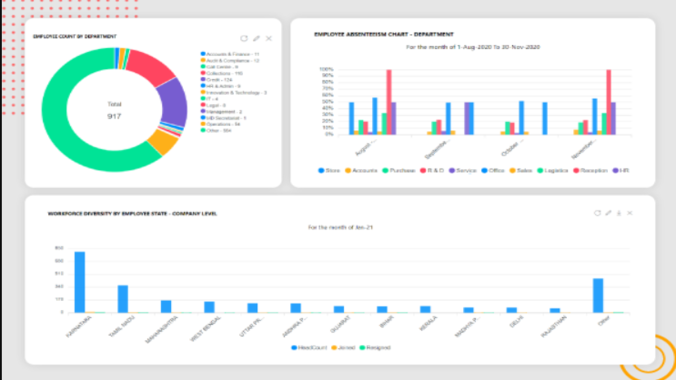
factoHR is a cloud-based, mobile-first Human Capital Management platform purpose-built for Indian businesses, and it earns the top position in this guide by the widest margin among the platforms reviewed. It is the only platform that simultaneously delivers the deepest Indian compliance coverage, the most intuitive mobile experience, and a proven track record at meaningful scale.
For Indian businesses specifically, factoHR’s geo-fenced attendance system is a standout capability. HR administrators can define custom geographical boundaries. The platform’s automated compliance engine is the most comprehensive and tested. It handles PF, ESIC, multi-state PT, TDS under both old and new regimes, LWF, and Form 16 generation.
Key Features:
- Automated payroll with full Indian statutory compliance
- Mobile-first attendance with geo-fencing and facial recognition
- Comprehensive performance management with customisable appraisal and OKR cycles
- Travel and expense management is integrated directly into the payroll engine
- Employee self-service mobile app for payslips, leave, expenses, and IT declarations
Pros:
- Strongest Indian compliance engine of all 12 platforms reviewed
- Outstanding mobile app that field staff, remote workers, and office employees actually use
- Fastest mid-market implementation (live within 2-4 weeks)
Cons:
- Very small businesses under 15 employees may find the feature breadth broader than needed
- UI customisation options are limited on entry-level pricing plans
Pricing: ₹4,999/month for up to 50 employees; ₹69/month per additional employee (billed quarterly)
Google Rating: 4.6/5
Best For: Indian SMEs from 20 to 500 employees needing mobile-first HRMS with the strongest available Indian statutory compliance coverage
2. Keka HR: Best for Mid-Size Companies with Dedicated HR Teams
Trust Signal: 10,000+ organisations | 2.5 million+ employees worldwide | Industries: Tech, BFSI, Pharma, Retail
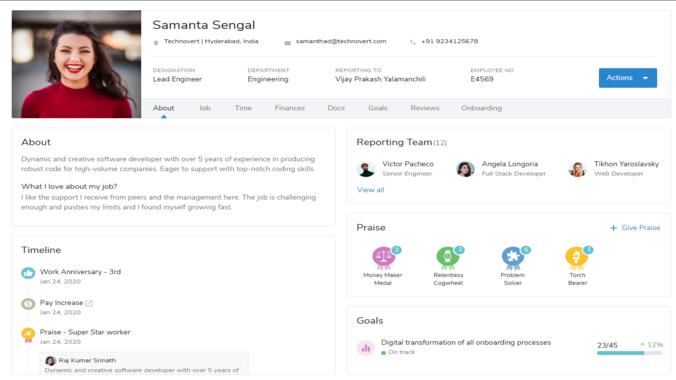
Keka HR is the most recognised mid-market HRMS brand in India. It earns the second position not simply because of its reach but because of the depth of its employee experience focus. Its clean, modern UI requires almost no onboarding training. The continuous feedback and OKR-based performance management system is particularly strong for technology companies. Keka’s applicant tracking system (ATS) and digital onboarding tools are the most capable in the mid-market category.
Key Features:
- Automated payroll with real-time TDS calculation and full Indian compliance
- Integrated ATS and fully digital onboarding with e-signature support
- OKR-based performance management with continuous feedback cycles
- Project-based timesheet management for billing and client tracking
Pros:
- Best-in-class user interface
- Outstanding for service and technology companies tracking billable hours
- Strong performance management
Cons:
- Among the highest-priced options reviewed
- Feature depth creates a noticeable learning curve for first-time HRMS administrators
Pricing: ₹9,999/month for up to 100 employees; ₹90/month per additional employee
Google Rating: 4.5/5
Best For: Mid-size Indian companies (100-1,000 employees) with dedicated HR teams
3. greytHR: Best for Payroll Compliance-Focused Organisations
Trust Signal: 25,000+ companies | 20+ years of Indian payroll experience | Trusted by manufacturing and production businesses
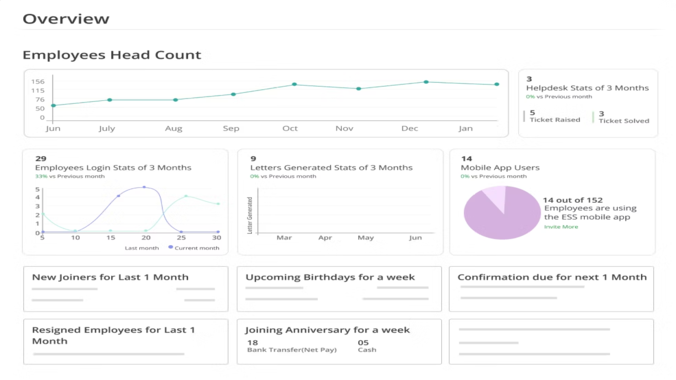
greytHR is the most battle-tested payroll compliance platform in India. If your primary evaluation criterion is bulletproof statutory compliance accuracy rather than modern user experience, greytHR is the most proven option available. The platform’s payroll engine handles scenarios that newer platforms frequently miscalculate: variable pay components, gratuity calculations, and multi-state PT for employees working across different states within the same month.
Key Features:
- Industry-leading payroll compliance engine refined over 20+ years
- Full PF, ESIC, PT, TDS, LWF, gratuity, and bonus calculations
- Centralised HR letter and document management with pre-built templates
- Mobile app for basic employee self-service
Pros:
- The most reliable payroll compliance engine reviewed
- Deep institutional knowledge is built into the platform
- Excellent pre-built HR letter templates
Cons:
- The user interface is noticeably dated
- Performance management is basic
- Limited customisation options for non-payroll HR workflows
Pricing: Starting at approximately ₹3,495/month for up to 50 employees
Google Rating: 4.3/5
Best For: Manufacturing, production, FMCG, and compliance-heavy organisations
4. Darwinbox: Best for Large Enterprises
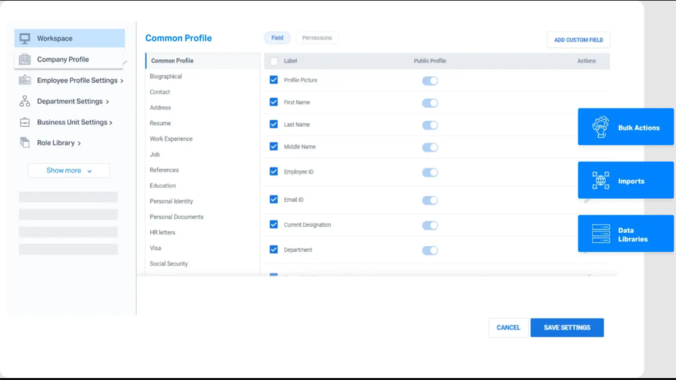
Trust Signal: 900+ enterprise clients | 4 million+ employees | Present in 110+ countries
Darwinbox is the premier enterprise-grade HRMS built in India. At the enterprise level, Darwinbox delivers capabilities that no other platform on this list can match: AI-driven talent acquisition with predictive candidate scoring, machine-learning-based attrition-risk models, voice-powered AI for employee query resolution, and multi-country payroll compliance.
Key Features:
- AI-driven talent acquisition, sourcing, and predictive candidate scoring
- Enterprise-grade security with granular role-based access controls
- Multi-country payroll and compliance management
Pros:
- The only Indian-built HRMS with genuine enterprise-scale configurability
- Best mobile app for enterprise users
- Advanced workforce analytics
Cons:
- Implementation cycles frequently run 3-6 months
- Enterprise pricing is generally not financially viable for companies under 200 employees
Pricing: Custom enterprise pricing (quotation-based)
Google Rating: 3.0/5
Best For: Large Indian enterprises (500+ employees) with complex structures
5. Zoho People: Best for Businesses in the Zoho Ecosystem
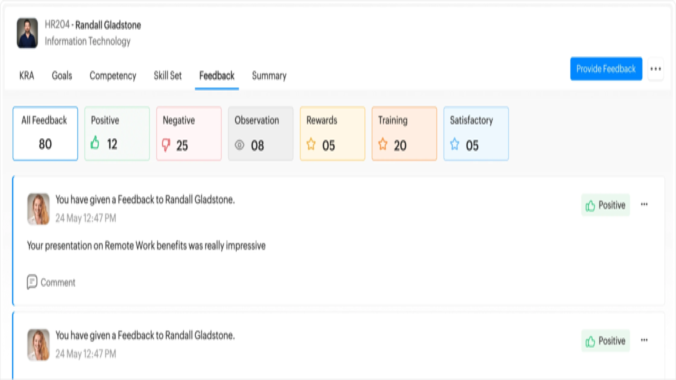
Trust Signal: 45,000+ businesses | 1 million+ employees | 165+ countries
Zoho People earns its position through one specific advantage: if your organisation already uses Zoho CRM, Zoho Books, and Zoho Projects, no other HRMS integrates with your existing technology stack as seamlessly. The platform’s drag-and-drop workflow builder is the most flexible custom configuration tool reviewed.
Key Features:
- Fully customisable HR workflows using drag-and-drop form builders
- Comprehensive performance appraisal with 360-degree feedback
- Native integration with all Zoho products
Pros:
- Best ecosystem integration for existing Zoho users
- Most flexible non-enterprise workflow customisation
- Competitive entry-level pricing
Cons:
- Indian payroll requires Zoho Payroll as a separate integration
- Less compelling for organisations not already using other Zoho products
Pricing: Starting at ₹48/user/month (annual billing); Zoho Payroll priced separately
Google Rating: 4.4/5
Best For: Businesses of any size already running on Zoho products
6. HROne: Best for Companies Moving From Manual Systems
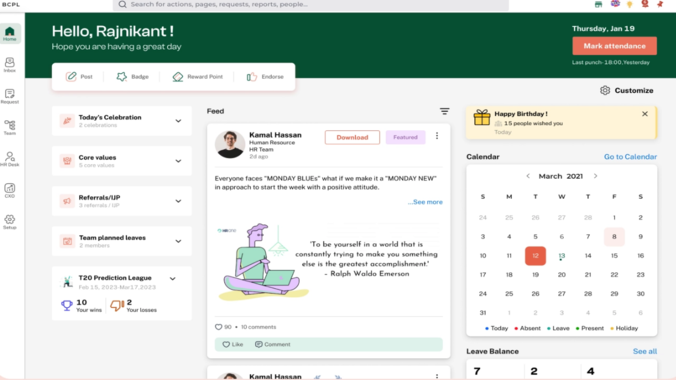
Trust Signal: 2,000+ brands | 20+ industries | 127 automated HR processes
HROne is designed to look and feel exactly like an email inbox. Every HR task appears as an actionable inbox message. This design philosophy gives HROne the fastest user adoption rate of any platform in this list.
Key Features:
- Inbox-style interface
- Full Indian payroll with PF, ESI, and TDS compliance
- Voice-powered Employee AI agent
Pros:
- The fastest user adoption of any platform reviewed
- Seamless automatic link between daily attendance and monthly payroll
Cons:
- Advanced learning management is less developed
- Not the optimal choice for enterprises above 1,000 employees
Pricing: Quotation-based
Google Rating: 4.8/5
Best For: Indian businesses of 50-500 employees transitioning from paper-based HR
7. Pocket HRMS: Best AI-Powered HRMS for SMEs With Distributed Workforces
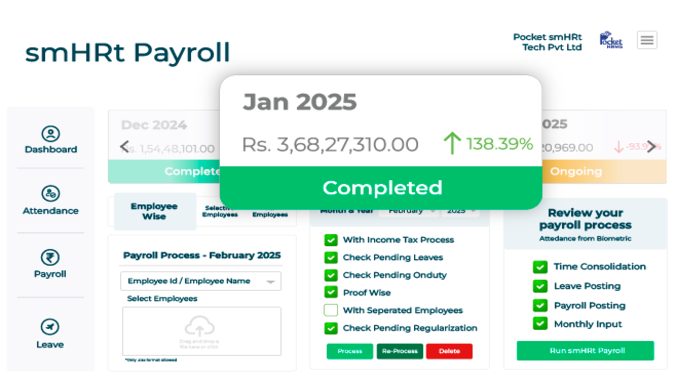
Trust Signal: 1,500+ clients | 3.5 million+ users | Powered by Microsoft Azure AI
Pocket HRMS is a cloud-native HRMS platform built specifically for Indian SMEs. Its defining capability is the 24/7 AI-powered HR chatbot, which handles employee queries without HR involvement. It also supports WhatsApp-based payslip delivery.
Key Features:
- 24/7 AI chatbot for employee self-service
- Facial recognition and GPS geolocation-based attendance
- WhatsApp payslip delivery
Pros:
- AI chatbot reduces repetitive HR queries by an estimated 30-40%
- WhatsApp payslip integration is genuinely practical
Cons:
- User interface design lags behind more modern platforms
- Custom reporting is limited to standard plans
Pricing: Starting at ₹60/employee/month
Google Rating: 4.2/5
Best For: SMEs under 500 employees with distributed or field-based workforces
8. Zimyo: Best for Startups Prioritising Employee Engagement
Trust Signal: 2,500+ customers | 40+ countries
Zimyo is designed for Indian startups that recognise employee engagement as a business-critical function. Its employee surveys, pulse checks, and peer recognition system give HR teams visibility into workforce sentiment.
Key Features:
- Full payroll with PF, ESIC, PT, and TDS compliance
- Employee engagement surveys and pulse checks
- Integrated ATS with digital onboarding
Pros:
- Treats employee engagement as a native core feature
- Modern, clean UI
Cons:
- Some modules feel less mature than established platforms
- Compliance handling for complex edge cases requires verification
Pricing: Starting at ₹80/user/month
Google Rating: 4.6/5
Best For: Startups and growth-stage companies (10-300 employees)
9. Spine HR Suite: Best for Multi-Location Businesses Needing End-to-End Coverage
Trust Signal: 10,000+ companies | 3 million+ monthly payslips | Clients include Bikaji, Being Human, Volvo-Eicher
Spine HR Suite processes over 3 million payslips monthly. What makes Spine HR Suite genuinely different is its fully native, single-platform architectureno integrations required between modules.
Key Features:
- Complete hire-to-retire workflow
- ERP integration with SAP, Oracle, and Tally
- Visitor management and HR helpdesk modules included
Pros:
- The most complete single-platform HRMS reviewed
- Proven at a genuine scale
Cons:
- Minimum headcount of 100 employees for standard pricing
- Implementation timelines run 6-8 weeks minimum
Pricing: ₹72/employee/month (minimum 100 employees)
Google Rating: 4.6/5
Best For: Multi-location businesses in manufacturing, FMCG, and retail
10. uKnowva HRMS: Best Customisable HRMS for Complex Industry Requirements
Trust Signal: 500,000+ users | 15+ industries | 8+ countries
uKnowva HRMS is an enterprise-grade platform purpose-built for deep process customisation. Its core differentiator is a configurable workflow engine that can accommodate virtually any approval hierarchy or policy rule without custom development.
Key Features:
- Fully configurable approval workflows
- AI-powered recruitment and onboarding
- Complete Indian compliance with flexible pay structure design
Pros:
- Unmatched configurability
- Highest Google rating in this list at 4.8/5
Cons:
- Quotation-based pricing makes budget comparison harder
- Significant initial setup time required
Pricing: Quotation-based
Google Rating: 4.8/5
Best For: Organisations across diverse industries needing high customisation
11. Qandle HR: Best Mobile-First Platform for Fast-Scaling Businesses
Trust Signal: 40+ integrated HR modules | AI-powered resume screening
Qandle HR brings together recruitment, attendance, payroll, performance, and employee engagement across 40+ integrated modules. Its AI-powered resume screening meaningfully accelerates high-volume recruitment.
Key Features:
- 40+ integrated HR modules
- AI-powered resume screening and automated candidate scoring
- One-click payroll processing
Pros:
- Broadest module coverage for SMEs
- The highest Google rating (5.0/5) of all platforms reviewed
Cons:
- Per-employee pricing is higher than simpler SME alternatives
- Information-dense UI can feel complex
Pricing: ₹2,450/month for up to 50 employees; ₹49/month per additional employee
Google Rating: 5.0/5
Best For: Fast-growing Indian businesses of 50-500 employees
12. WoCo: Best Budget-Friendly All-in-One HRMS for Growing SMEs
WoCo is a modern, cloud-based HRMS built on the principle that HR software should eliminate spreadsheets entirely. At ₹50/employee/month with a minimum of 25 employees, WoCo offers one of the most accessible entry points. Its direct customer support model with phone access is particularly valued.
Key Features:
- Complete Indian payroll processing with statutory compliance
- Attendance management with geo-attendance and kiosk check-in options
- Customisable onboarding and offboarding workflow
Pros:
- Among the most affordable full-featured HRMS platforms
- Direct phone-based customer support
Cons:
- Smaller brand presence than established players
- Geo-attendance, PMS, and kiosk check-in are add-on modules
Pricing: ₹50/employee/month (minimum 25 employees)
Google Rating: 4.0/5
Best For: Small and growing Indian SMEs of 25-300 employees
HRMS Software Pricing in India (2026) Complete Comparison
HRMS software pricing in India ranges from approximately ₹15 to ₹150 per employee per month for standard cloud-based plans. Enterprise solutions are typically quotation-based.
| Platform | Starting Price | Pricing Model | Free Trial Available? |
|---|---|---|---|
| factoHR | ₹4,999/month (up to 50 employees) | Per-employee, billed quarterly | Yes |
| Keka HR | ₹9,999/month (up to 100 employees) | Per-employee, monthly | Yes |
| greytHR | ~₹3,495/month (up to 50 employees) | Per-employee, monthly | Yes |
| Darwinbox | Custom enterprise pricing | Annual contract | On request |
| Zoho People | ₹48/user/month (annual billing) | Per-user, monthly/annual | 30-day free trial |
| HROne | Quotation-based | Custom | On request |
| Pocket HRMS | ₹60/employee/month | Per-employee, monthly | Yes |
| Zimyo | ₹80/user/month | Per-user, monthly | Yes |
| Spine HR Suite | ₹72/employee/month (min. 100 emp) | Per-employee, monthly | On request |
| uKnowva HRMS | Quotation-based | Custom | On request |
| Qandle HR | ₹2,450/month (up to 50 employees) | Flat + per-employee | Yes |
| WoCo | ₹50/employee/month (min. 25 emp) | Per-employee, monthly | Yes |
Important note on hidden costs: The per-employee prices above are base advertised rates. Before signing any contract, verify whether one-time setup fees, compliance modules, or mobile app access are charged separately. Hidden costs typically add 30-50% to the base price.
Final Verdict: Which HRMS Should You Choose?
Different businesses need different tools. Use this decision guide to find your match:
- If you are a startup or small business (10-50 employees) on a tight budget, choose WoCo (₹50/employee/month) or Pocket HRMS (₹60/employee/month).
- If you are a growing SME (50-200 employees) in need of your first serious HRMS, choose factoHR.
- If you are a mid-size company (100-500 employees) with a dedicated HR team, choose Keka HR.
- If employee engagement is a strategic priority, choose Zimyo.
- If you need to transition from paper or Excel with minimal resistance, choose HROne.
- If your primary concern is payroll accuracy and statutory compliance, choose greytHR.
- If you are already running on Zoho products: Choose Zoho People + Zoho Payroll.
- If you operate across multiple locations with complex hierarchies, choose Spine HR Suite.
- If you need deep customisation for non-standard industry processes, choose uKnowva HRMS.
- If you need AI-powered recruitment for high-volume hiring, choose Qandle HR.
- If you are a large enterprise (500+ employees), choose Darwinbox.
How to Implement Your New HRMS Successfully
Selecting the right HRMS is only 40% of the outcome. Follow this process to avoid the most common implementation mistakes.
Step 1: Clean your existing employee data before migration.
Export your current employee records from Excel and thoroughly audit them. Migrating inaccurate data into a new HRMS creates cascading payroll errors.
Step 2: Map your Indian compliance requirements to the new system.
Before configuration begins, document your specific compliance scope (states operated in, ESIC-eligible employees, PF trust structure). Hand this to your vendor’s implementation team on Day 1.
Step 3: Appoint one internal HRMS champion, not a committee.
The single most common implementation failure is “shared ownership.” Assign one person to own the configuration decisions and be accountable for the go-live date.
Step 4: Run parallel payroll for at least one month.
Run your existing payroll process and the new system simultaneously for one complete cycle. Compare the outputs line-by-line.
Step 5: Roll out in phases, not all at once.
Start with payroll and attendance. Once stable, add leave management and employee self-service. Then add performance management.
Step 6: Train employees using the mobile app, not the desktop version.
Train your workforce on the mobile experience specifically. If applying for leave and downloading a payslip work smoothly on mobile, you have succeeded.
Conclusion
Choosing the Best HRMS Software in India is one of the most impactful operational decisions a growing business can make. The right platform eliminates payroll errors, automates attendance tracking, ensures statutory compliance, and frees your HR team to focus on strategic work.
Whatever you choose, do not stay on spreadsheets. The cost of payroll errors, compliance penalties, and frustrated employees will always exceed the cost of implementing a proper HRMS. Start with a demo of the platform that fits your profile, run a pilot cycle, and commit to the switch.
Frequently Asked Questions About HRMS Software in India
1. What is HRMS software?
HRMS (Human Resource Management System) is a digital platform that automates the entire employee lifecycle, from payroll processing, attendance tracking, and leave management to statutory compliance, performance reviews, and employee self-service.
2. What is the difference between HRMS, HRIS, and HCM?
HRIS focuses primarily on storing employee data. HRMS builds on HRIS by adding payroll, attendance, and compliance processing. HCM is the broadest term, encompassing HRMS features and strategic functions such as talent management.
3. Which is the best HRMS software for small businesses in India?
For small Indian businesses (10-100 employees), factoHR, Pocket HRMS, WoCo, and HROne are the strongest options.
4. How much does HRMS software cost in India?
HRMS pricing typically ranges from ₹15 to ₹150 per employee per month for cloud-based plans. Budget options start at ₹50/employee/month, while mid-range platforms start around ₹9,999/month for up to 100 employees.
5. Can HRMS software handle Indian payroll and statutory compliance?
Yes, the best platforms natively process PF, ESIC, Professional Tax (with state-wise slab variations), TDS under both tax regimes, LWF, and Form 16 generation.
6. Is cloud-based HRMS better than desktop-based software?
Yes. Cloud-based HRMS is the standard in 2026. It offers access from any device, automatic compliance updates, and no capital expenditure.
7. How long does it take to implement HRMS software?
Small businesses using platforms like factoHR or WoCo can typically go live within 2-4 weeks. Mid-size implementations take 4-8 weeks, while enterprise deployments may require 3-6 months.
8. Which HRMS is best for manufacturing companies in India?
Manufacturing companies typically need shift management, biometric attendance, and robust compliance. Spine HR Suite and greytHR are the strongest for manufacturing.
9. How do I migrate from Excel to HRMS software?
The process involves exporting employee records and salary details from your Excel files, standardising the data, importing it into the new HRMS, and running a parallel payroll cycle to verify accuracy.
10. Does HRMS software support remote and hybrid teams?
Yes. Modern platforms provide mobile apps for attendance marking, GPS-based location tracking, and digital onboarding for remote hires.
11. What features should the best HRMS software in India include?
Essential features include automated payroll with statutory compliance, integrated attendance tracking with payroll, leave management, an employee self-service portal, performance management, and HR analytics.
12. Does HRMS software work for companies with fewer than 50 employees?
Yes. Several platforms are designed for small teams. WoCo accepts companies with 25 employees, and Pocket HRMS has no minimum.
